
Understand
40%
of enterprise applications are forecast to include task-specific AI agents by the end of 2026, up from under 5%.
Gartner, August 20251An AI agent is not a smarter chatbot. It is a system that can own a result.
If the software only answers questions, it is an assistant. If it can gather context, take action, and stop at defined control points, it can change the economics of a workflow.

How I see it
What are AI Agents?
An AI agent is a system that can gather context, take action, and own a result until the work is done.
Most teams meet AI as a chat window, then wrap tools around it and call it an agent. That is still a writing aid. The ticket still waits. The CRM still needs an update. Someone still has to finish the job.
They do that because they only see the product layer. Over the years, I have built many AI agent engines from the ground up. The failures that look like a bad prompt or a weak integration start lower: incomplete observations, a wrong objective, a fluent trajectory that is already wrong.
You do not need a more autonomous model. You need the expensive work to finish: the ticket closed, the CRM current, the follow-up done. Nobody should still be picking up the leftover steps.
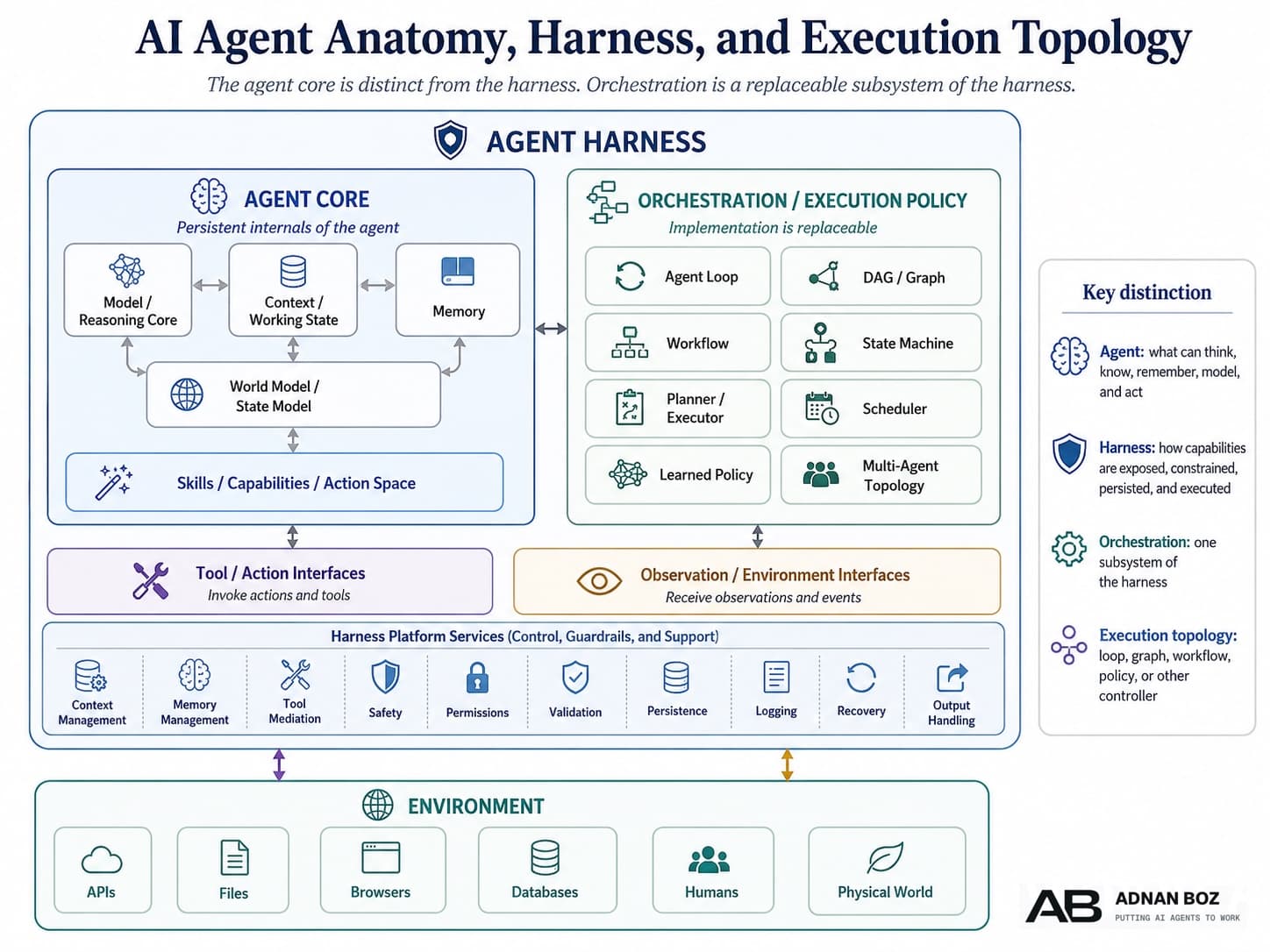
The anatomy
An AI agent is a surprisingly complex stack of reasoning, memory, context, tools, permissions, state, orchestration, and feedback mechanisms. The way those layers are designed determines what users experience at the surface, what work the system can actually complete, and ultimately which operational decisions improve or degrade business outcomes.
Common mistakes
What teams usually get wrong.
Calling every chatbot an agent
If a person still has to copy the answer into three systems, you have a writing aid. The workflow cost is unchanged.
Confusing autonomy with value
A fully unsupervised agent on a low-value task is a novelty. A supervised agent on a $135K workflow is an operating decision.
Skipping the definition of done
Teams launch agents that generate activity. Operators need completed outcomes, exceptions, and an audit trail.
A useful diagnostic
Five questions before you fund the work.
Can you name the outcome the system is responsible for?
If you can only name a task, you are still in copilot territory.Does the system take action in business tools, or only produce text?
Text without write-back leaves the expensive work with people.Are there explicit stop conditions and human approvals?
No control points means either too much risk or no real authority.Can you tell a completed case from a stalled one?
If status is unclear, the agent cannot be operated.Would a simpler automation or a better checklist get most of the value?
If yes, do not dress it up as an agent.
Economic model
Agent vs. assistant testoutcome ownership + tool use + write-back + human control points = agent
If any of those are missing, you likely have a copilot, a search tool, or a prototype.
Three credible paths
How far should you go?
Do not force one solution. Choose the path the economics, the risk, and the organization can support.
Improve the work you already have
Keep the process mostly intact and use AI on the bottlenecks that create delay, rework, or follow-up.
The workflow is already sound and a few steps create most of the friction.
Gains are usually incremental. The operating economics do not change much.
Redesign the workflow around AI
Question every handoff, queue, and duplicate step, then rebuild the process around what AI can now do.
The process grew over years and coordination now costs more than the work itself.
Requires process change, clearer ownership, and a willingness to retire old steps.
Put an agent on a high-value outcome
Give an agent responsibility for one valuable result across systems, with humans at the control points that require judgment, authority, or risk acceptance.
The workflow is high-value, variable, multi-step, and worth engineering for production.
Needs stronger architecture, evaluation, controls, and monitoring. This is not a prompt project.
When this is the wrong next step
Do not fund an agent here.
- The job is one-off analysis that a skilled person should do once.
- The company cannot grant system access or define approval authority.
- The work is mostly conversation with no durable business object to complete.

A useful next step
Bring one workflow. Get guided into production.
We guide the implementation, go deep on the technical path, and stay hands-on through operations — or tell you when a simpler answer is better.
Discuss an AI opportunity